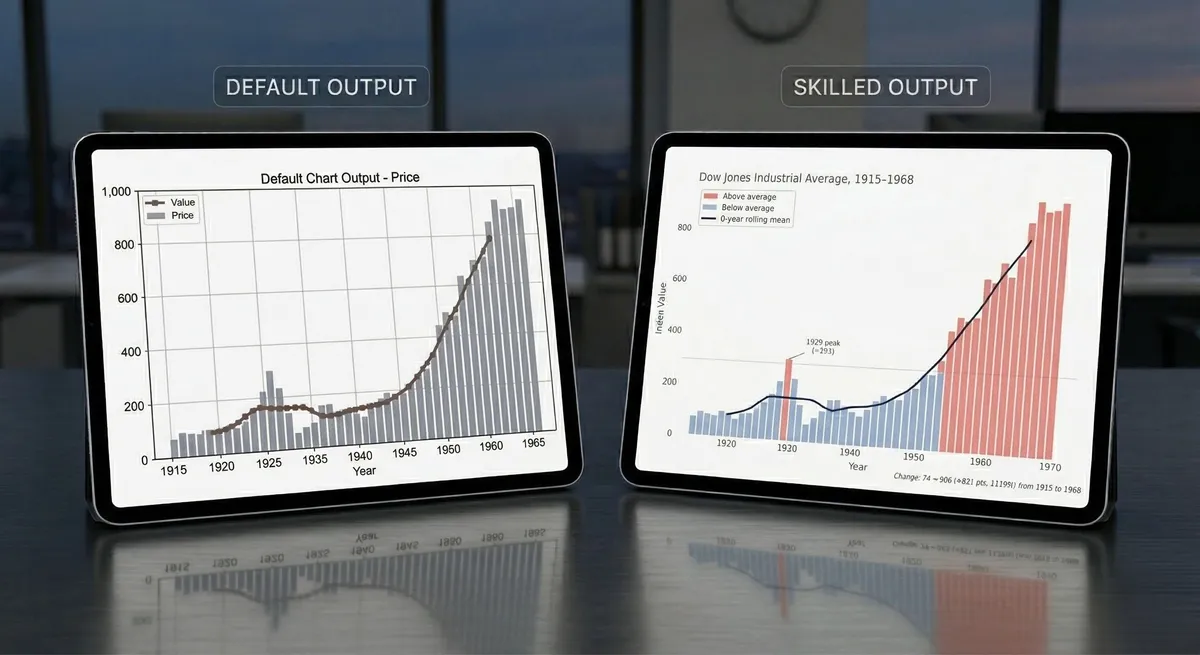
I Taught Claude to Make Beautiful Charts. Then It Forgot How.
How I built a Claude Code skill for publication-quality matplotlib charts over 50 iterations — and what happened when I automated its improvement.
Claude CodeSkillsMatplotlib
Articles about machine learning, manufacturing, and data science
15 articles about machine learning, manufacturing, and data science
How I built a Claude Code skill for publication-quality matplotlib charts over 50 iterations — and what happened when I automated its improvement.
Why build an open-source package for machinery data?


Music to my ears... err... eyes? The violin plot is a worthy tool for any data visualization tool box. Let's build one, in Plotly, as we explore historic birth trends in the USA!

Using Jupyter Notebooks in a high performance computing environment is easy! This tutorial will show you how.
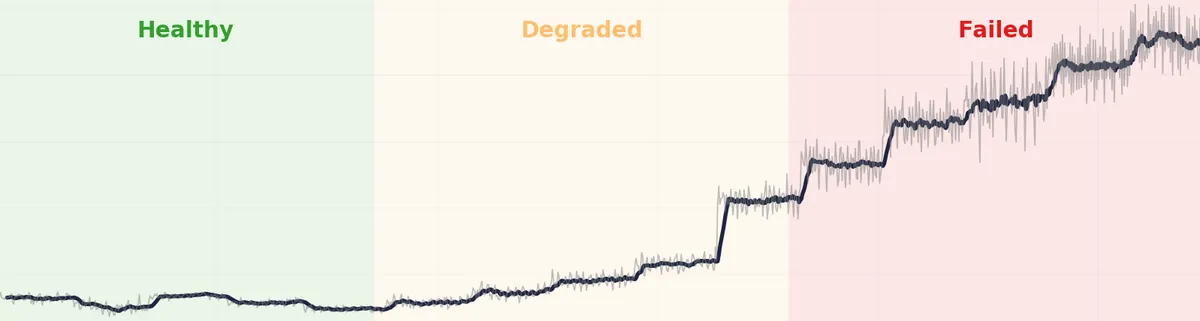
We've trained the variational autoencoders, and in this post, we see how the models perform in anomaly detection. We check both the input and latent space anomaly detection effectiveness.
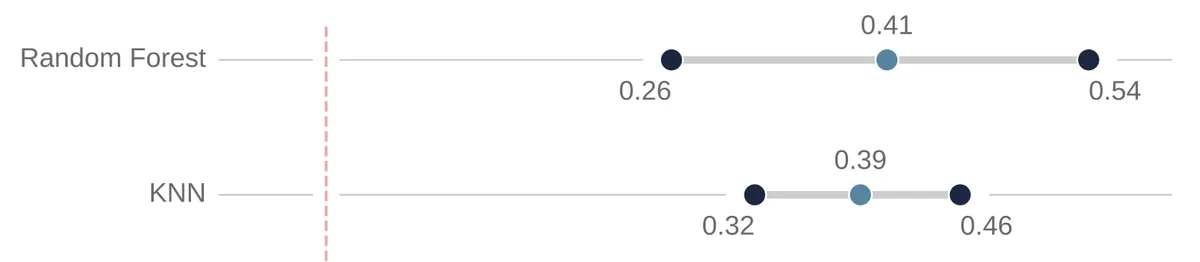
The lollipop chart is great at visualizing differences in variables along a single axis. In this post, we create an elegant lollipop chart, in Matplotlib, to show the differences in model performance.
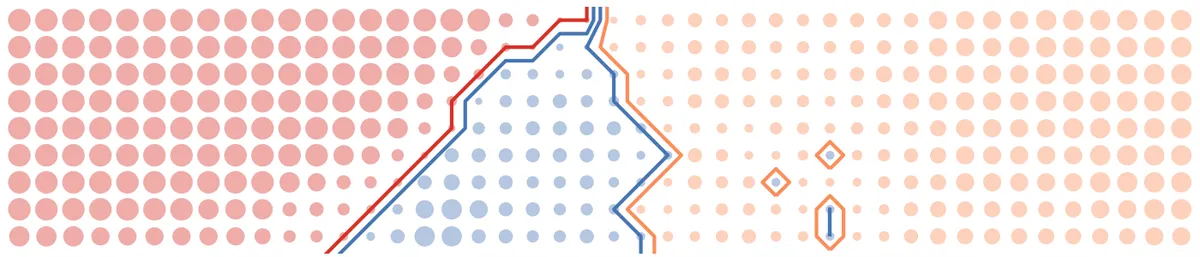
How can we communicate complex concepts using data visualization tools? In this first post -- in a series titled 'Beautiful Plots' -- we build an elegant chart demonstrating the decision boundary from a KNN classifier.
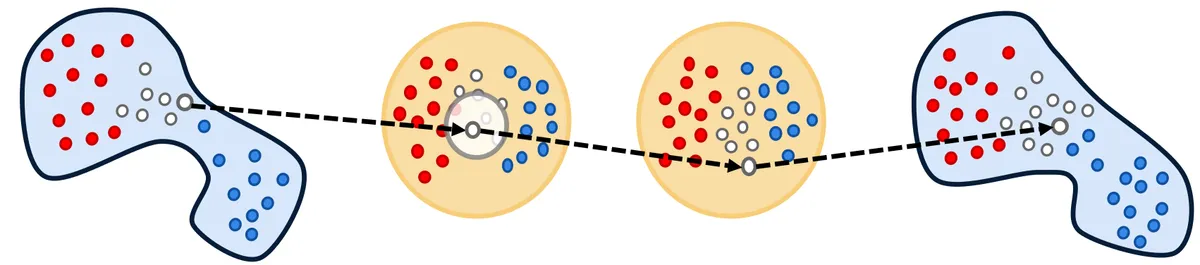
In this post, we'll explore the variational autoencoder (VAE) and see how we can build one for use on the UC Berkeley milling data set. A variational autoencoder is more expressive than a regular autoencoder, and this feature can be exploited for anomaly detection.
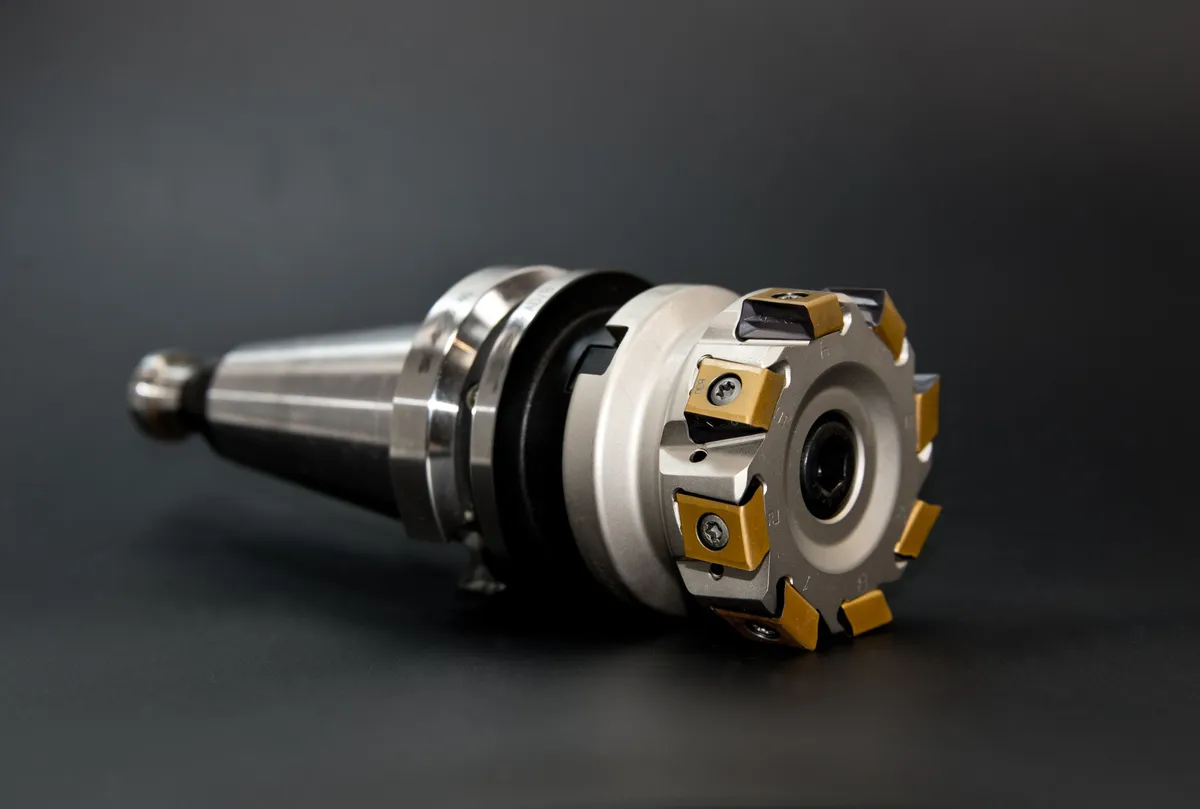
Data exploration is an important first step in any new data science problem. In this post we introduce a metal machining data set that we'll use to test anomaly detection methods. We'll explore the data set, see how it is structured, and do some data visualization.
Machines fail. Anomaly detection, using an autoencoder, can be used to identify failures that have never been seen before.
Feature engineering can be powerful tool, but it doesn't have to be complicated. Often, the simple solution is best.
In part two, we give an overview of the two data-driven approaches in condition monitoring; that is, feature engineering and end-to-end deep learning. Which approach should you use? Well, it all depends...
Why care about data-driven condition monitoring techniques? In this post, we articulate the business case for using these advanced methods in an industrial environment.